
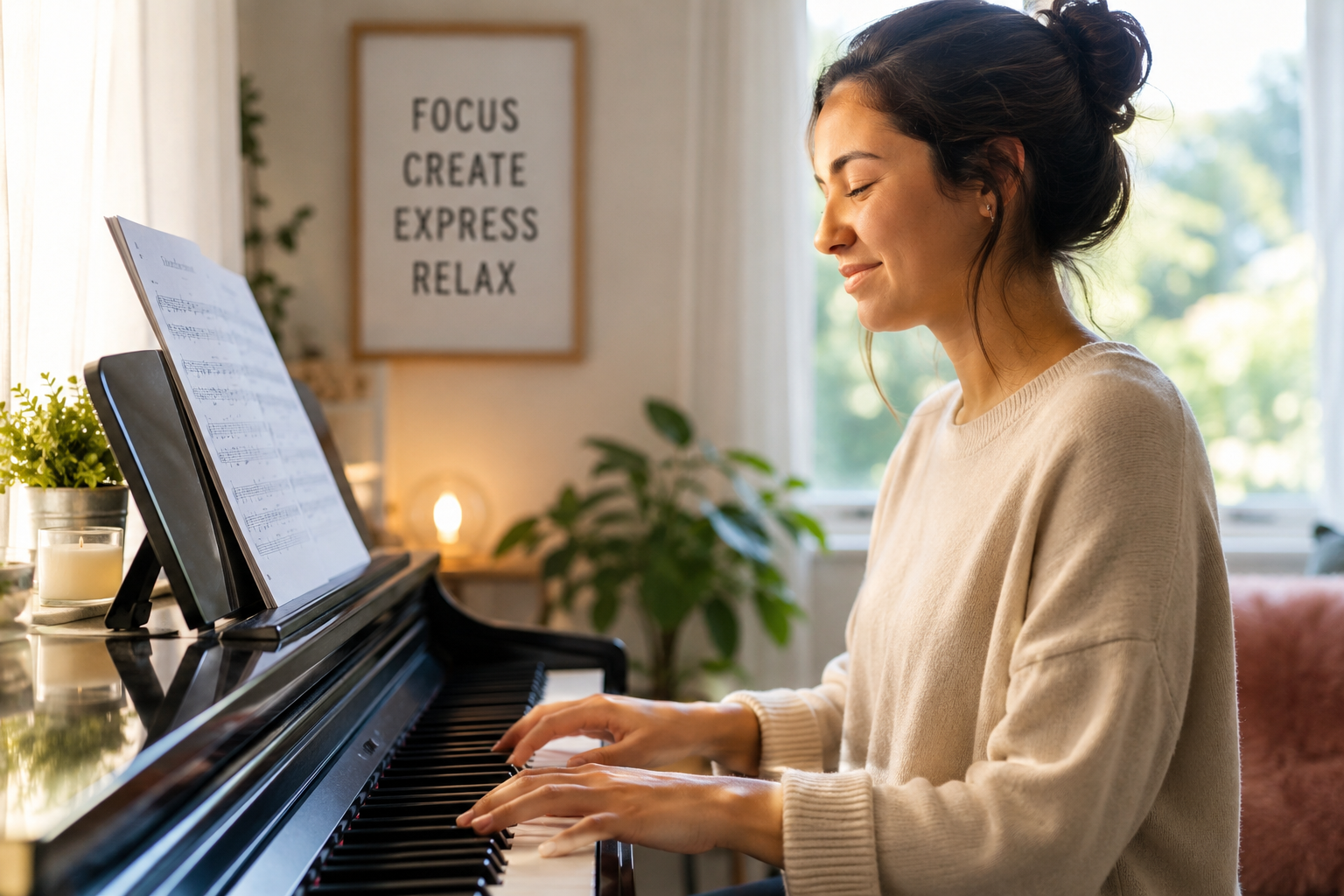
Discover how learning piano can support mental health, reduce stress, improve focus, and give children and adults a meaningful creative outlet.
Music has a special way of reaching us. A song can calm us down after a long day, bring back a memory, lift our mood, or help us express feelings that are hard to put into words. For many people, music is more than entertainment. It becomes a source of comfort, focus, confidence, and emotional balance.
At Worldwide Music School, we see this every day. Students come to piano lessons for many reasons. Some want to learn their favorite songs. Some parents want their children to build discipline and confidence. Some adults finally want to do something creative for themselves. But over time, many students discover another benefit. Piano becomes a place to slow down, breathe, think, and feel better.
Learning piano is not just about notes on a page. It is about giving the mind something meaningful to focus on.
Music Can Help Reduce Stress
Most people already know from experience that music can change the way they feel. A peaceful song can soften a stressful moment. An upbeat rhythm can bring energy into the room. A familiar melody can make someone feel less alone.
Playing music can take that even further. When you sit at a piano, your attention shifts away from the stress of the day and toward the sound, rhythm, motion, and feeling of the music. Your hands are moving. Your ears are listening. Your eyes are following patterns. Your mind is engaged in the present moment.
That combination can be very powerful.
For children, this can be a healthy way to release energy and emotions. For teens, piano can become a positive outlet during a busy school year. For adults, even a few minutes of playing can feel like a reset from work, responsibilities, and constant screen time.
You do not have to be an advanced musician to experience this. Even simple music can be calming when it gives the brain a focused, creative activity.
Piano Encourages Mindfulness
Mindfulness simply means paying attention to the present moment. You do not need to sit silently in a room to practice it. Piano can create a natural form of mindfulness because it asks you to listen closely and respond in real time.
When you play piano, you notice things like:
The weight of your fingers on the keys
The sound of each note
The shape of a melody
The feeling of rhythm
The difference between playing softly and loudly
The coordination between both hands
These small details pull your attention into the moment. Instead of thinking about everything at once, your mind focuses on one meaningful task.
This is one reason piano can be helpful for people who feel mentally scattered. It gives structure to attention. It turns focus into sound. It makes concentration feel rewarding.
Music Gives Emotions a Healthy Outlet
Not every feeling is easy to explain. Sometimes a student may feel frustrated, nervous, sad, excited, or overwhelmed, but not have the words for it. Music gives those feelings somewhere to go.
A slow piece can help someone process a heavy mood. A lively piece can bring joy and movement. A dramatic piece can give energy to emotions that might otherwise stay bottled up.
This is especially important for children and teens. Piano lessons can help them develop emotional awareness without forcing them to talk about every feeling directly. They learn that music can express many moods, and they begin to recognize those moods in themselves.
For adults, piano can be just as meaningful. Many adults spend years focusing on work, family, and obligations. Returning to music, or starting for the first time, can feel like reclaiming a personal part of life.
Piano Builds Confidence
Mental health is not only about reducing stress. It is also about building confidence, purpose, and a sense of progress.
Piano does this beautifully because growth is visible. A student starts with a few notes. Then a short melody. Then a full song. Each step shows them that improvement is possible.
This matters for children because they learn that effort leads to progress. They learn patience. They learn how to work through mistakes. They learn that being “bad” at something in the beginning is not failure. It is part of learning.
Adults need this reminder too. Many adults are afraid to start because they think it is too late, or they worry they will not be good enough. But piano is not limited to children. Adults can make real progress, and the process itself can be deeply rewarding.
Every small success builds confidence.
Piano Supports Brain Health
Learning an instrument challenges the brain in many ways at once. A pianist reads patterns, listens to sound, coordinates both hands, follows rhythm, uses memory, and makes musical decisions. That is a full brain workout.
This is one reason music study is often connected with cognitive benefits. Piano asks the brain to stay active, flexible, and engaged. It combines creativity with structure.
For older adults, this can be especially valuable. Learning something new keeps the mind challenged. Piano also offers a sense of routine and accomplishment, which can support overall well being. Research has even looked at how piano training may help support brain structure in older adults, especially when compared with more passive music activities.
The important point is simple. Piano is active. You are not just consuming sound. You are creating it.
Music Can Help Create Better Daily Routines
A healthy routine can make a big difference in mental well being. Piano practice gives students a positive habit that can fit into daily life.
This does not mean practicing for hours. Even ten to fifteen minutes a day can be meaningful, especially for beginners. The goal is not perfection. The goal is consistency.
A short piano routine can become:
A calming start to the day
A break after school
A screen free evening activity
A way to relax before bed
A creative outlet after work
For families, music can also bring people together. A child practicing at home, a parent listening, or siblings singing along can turn music into a shared experience.
You Do Not Need to Be “Musical” to Benefit
One of the biggest myths about piano is that you must already have talent to begin. That is simply not true.
Beginners can start with simple patterns, basic chords, familiar songs, and easy melodies. The emotional benefits of music do not require advanced technique. A student can enjoy the feeling of playing long before they become highly skilled.
This is especially encouraging for adults who may have waited years to begin. You do not need to read music perfectly. You do not need to have fast fingers. You do not need to know theory before you start.
You just need a willingness to learn.
Piano Lessons Add Personal Connection
While online videos and apps can be helpful, private lessons add something important: human connection.
A good teacher notices when a student is frustrated. They know when to slow down, when to encourage, and when to celebrate progress. They help students feel supported, not judged.
That support matters. A student who feels safe is more likely to keep going. A student who feels encouraged is more likely to believe in themselves. A student who enjoys lessons is more likely to build music into their life long term.
At Worldwide Music School, we believe music education should be personal. Every student has different goals, different learning styles, and different reasons for wanting to play.
Piano Is More Than a Skill
Learning piano gives students something they can carry with them for life. It can become a hobby, a discipline, a comfort, a creative outlet, and a source of joy.
In a world filled with distractions, stress, and constant noise, piano gives people a chance to make something beautiful with their own hands. That is powerful.
Whether you are a parent looking for a positive activity for your child, a teen who needs a creative outlet, or an adult who has always wanted to learn, piano can be a wonderful place to start.
Music will not solve every problem. It is not a replacement for professional mental health care when that is needed. But it can be a meaningful part of a healthier, more balanced life.
And sometimes, sitting down at the piano and playing a few notes is exactly the kind of peace we need.
Start Learning Piano With Worldwide Music School
Worldwide Music School offers piano lessons for children, teens, and adults at every level. Whether you are brand new or returning after many years, our teachers can help you build confidence, enjoy the process, and make music part of your life.
If you have been thinking about starting lessons, this is a great time to begin. Piano is not just something you learn. It is something that can support your mind, your mood, and your everyday life.