
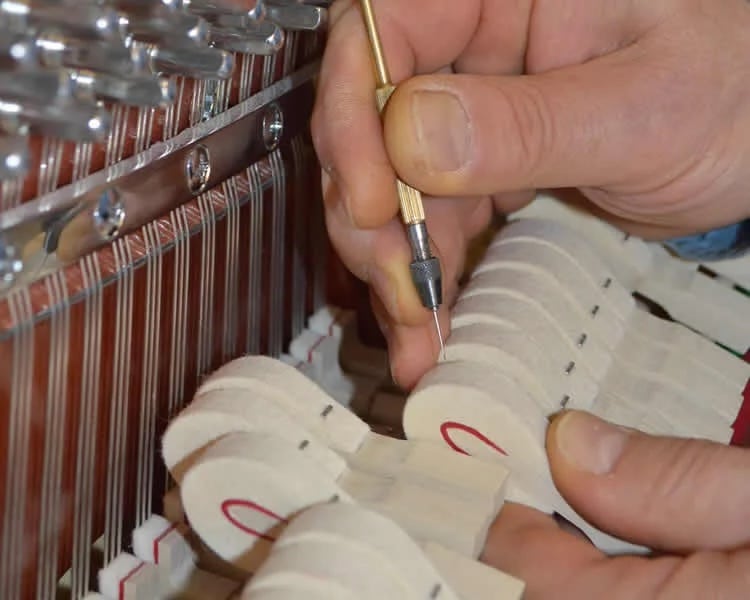
Customizing the sound of a piano
Every piano has a tonal personality. Some instruments sound bright and powerful, while others are warm and mellow. What many piano owners do not realize is that this tone is not fixed. It can be shaped and refined through a process called piano voicing.
At Worldwide Piano, we regularly voice pianos to bring out their best sound. A piano that feels harsh can often be made warmer. A piano that sounds dull can be given more clarity and projection. In both cases, the hammer felt is where the transformation happens.
What Is Piano Voicing?
Piano voicing is the process of adjusting the hammer felt to change the tone of the instrument. Since the hammer strikes the string, its density, shape, and elasticity directly affect the sound you hear.
Over time, hammers become compacted and develop grooves from repeated use. This usually creates a brighter, harder tone. Voicing allows a technician to reverse or refine that process and shape the piano into something more balanced and musical.
The Main Piano Voicing Techniques
There are several ways to change the tone of a piano. Interestingly, different techniques can often lead to similar results. The difference comes down to speed, precision, and control.
Needling the Hammers
Needling is one of the most precise voicing techniques. A technician uses a specialized tool with fine needles to loosen compacted hammer felt fibers. This reduces harshness and creates a warmer tone.
- Shoulder needling softens the tone while maintaining clarity
- Attack point needling reduces brightness and initial bite
- Deep needling produces a broader tonal change
- Shallow needling allows for subtle adjustments
Needling is ideal for fine tuning. It allows technicians to balance individual notes and refine the tone across the keyboard.
Steaming the Hammers With an Iron or Teapot Device
When a piano is too bright overall, steaming is often the fastest way to warm it up. Using an iron with a damp cloth or a controlled steam device, moisture is introduced into the hammer felt.
This causes the felt fibers to expand and relax, making the hammers softer and producing a rounder, more mellow tone across the entire piano.
If you need to take a whole piano voice and make it warmer, steaming is the quickest and easiest way to do it. Needling can then be used afterward to fine tune the result.
Steaming must be done carefully. Too much heat or moisture can over soften the hammers and reduce clarity. When done properly, it is one of the most efficient ways to shift the tonal baseline of a piano.
Lacquer and Hardening the Hammers
If a piano sounds too soft or lacks projection, technicians may apply lacquer or other hardening solutions to the hammer felt. This stiffens the fibers and creates a brighter, more projecting sound.
This process must be done with precision. A small amount can restore clarity. Too much can make the piano sound harsh or thin.
Different Methods, Same Goal
One of the most interesting aspects of piano voicing is that different techniques can achieve similar tonal results.
- A bright piano can be softened through steaming or needling
- A dull piano can be brightened with lacquer or selective adjustments
- Multiple approaches can reach the same tonal outcome
The key difference is how quickly the result is achieved and how precisely it can be controlled.
Why Piano Voicing Matters
A properly voiced piano is more expressive, more balanced, and more enjoyable to play. Two identical pianos can sound completely different depending on how they are prepared.
If your piano sounds too bright, too dull, or uneven, professional voicing can make a dramatic difference. At Worldwide Piano, we provide expert piano preparation and voicing services for customers throughout New Jersey. You can schedule a consultation here to hear the difference for yourself.
If you are shopping for a piano, preparation matters. You can explore our current piano inventory here.
Final Thoughts
Piano voicing is where technical skill meets artistry. Whether using steam, needling, or lacquer, the goal is always the same, to create a tone that inspires the player.
Steaming is often the fastest way to warm an entire piano. Needling provides precision and refinement. Hardening techniques can bring back brilliance when needed. The best results come from knowing when to use each method.
Ready to Experience the Difference?
Visit Worldwide Piano or schedule a consultation to experience the difference proper voicing makes.