Pianos for Sale

Customizing the sound of a piano

Every piano has a tonal personality. Some instruments sound bright and powerful, while others are warm and mellow. What many piano owners do not realize is that this tone is not fixed. It can be shaped and refined through a process called piano voicing.

At Worldwide Piano, we regularly voice pianos to bring out their best sound. A piano that feels harsh can often be made warmer. A piano that sounds dull can be given more clarity and projection. In both cases, the hammer felt is where the transformation happens.

What Is Piano Voicing?

Piano voicing is the process of adjusting the hammer felt to change the tone of the instrument. Since the hammer strikes the string, its density, shape, and elasticity directly affect the sound you hear.

Over time, hammers become compacted and develop grooves from repeated use. This usually creates a brighter, harder tone. Voicing allows a technician to reverse or refine that process and shape the piano into something more balanced and musical.

The Main Piano Voicing Techniques

There are several ways to change the tone of a piano. Interestingly, different techniques can often lead to similar results. The difference comes down to speed, precision, and control.

Needling the Hammers

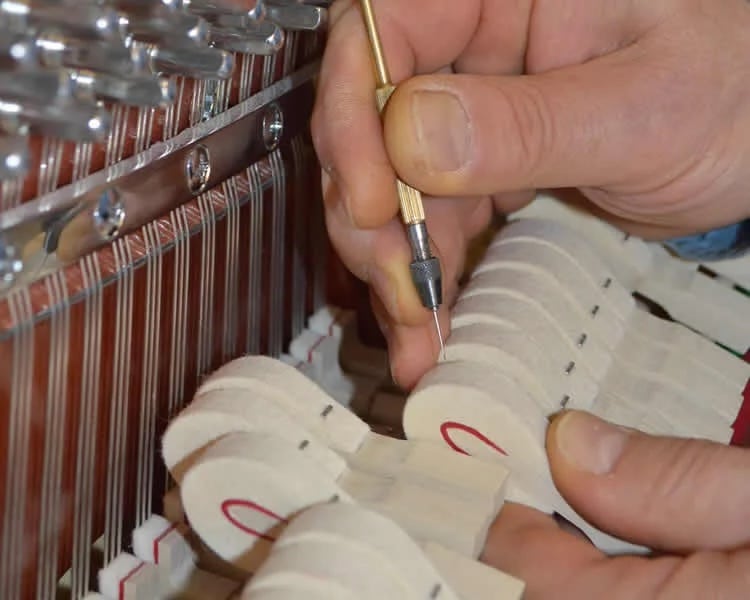
Needling is one of the most precise voicing techniques. A technician uses a specialized tool with fine needles to loosen compacted hammer felt fibers. This reduces harshness and creates a warmer tone.

  • Shoulder needling softens the tone while maintaining clarity
  • Attack point needling reduces brightness and initial bite
  • Deep needling produces a broader tonal change
  • Shallow needling allows for subtle adjustments

Needling is ideal for fine tuning. It allows technicians to balance individual notes and refine the tone across the keyboard.

Steaming the Hammers With an Iron or Teapot Device

When a piano is too bright overall, steaming is often the fastest way to warm it up. Using an iron with a damp cloth or a controlled steam device, moisture is introduced into the hammer felt.

This causes the felt fibers to expand and relax, making the hammers softer and producing a rounder, more mellow tone across the entire piano.

If you need to take a whole piano voice and make it warmer, steaming is the quickest and easiest way to do it. Needling can then be used afterward to fine tune the result.

Steaming must be done carefully. Too much heat or moisture can over soften the hammers and reduce clarity. When done properly, it is one of the most efficient ways to shift the tonal baseline of a piano.

Lacquer and Hardening the Hammers

If a piano sounds too soft or lacks projection, technicians may apply lacquer or other hardening solutions to the hammer felt. This stiffens the fibers and creates a brighter, more projecting sound.

This process must be done with precision. A small amount can restore clarity. Too much can make the piano sound harsh or thin.

Different Methods, Same Goal

One of the most interesting aspects of piano voicing is that different techniques can achieve similar tonal results.

  • A bright piano can be softened through steaming or needling
  • A dull piano can be brightened with lacquer or selective adjustments
  • Multiple approaches can reach the same tonal outcome

The key difference is how quickly the result is achieved and how precisely it can be controlled.

Why Piano Voicing Matters

A properly voiced piano is more expressive, more balanced, and more enjoyable to play. Two identical pianos can sound completely different depending on how they are prepared.

If your piano sounds too bright, too dull, or uneven, professional voicing can make a dramatic difference. At Worldwide Piano, we provide expert piano preparation and voicing services for customers throughout New Jersey. You can schedule a consultation here to hear the difference for yourself.

If you are shopping for a piano, preparation matters. You can explore our current piano inventory here.

Final Thoughts

Piano voicing is where technical skill meets artistry. Whether using steam, needling, or lacquer, the goal is always the same, to create a tone that inspires the player.

Steaming is often the fastest way to warm an entire piano. Needling provides precision and refinement. Hardening techniques can bring back brilliance when needed. The best results come from knowing when to use each method.


Ready to Experience the Difference?

Visit Worldwide Piano or schedule a consultation to experience the difference proper voicing makes.

If you are shopping for a piano, you will quickly come across terms like OEM, stencil, and designed by Steinway. These phrases can sound reassuring, but they often create more confusion than clarity.

The truth is simple. Not all piano brands actually build their own instruments, and not all brand names reflect the true quality of the piano. Understanding the difference between a stencil piano vs OEM piano can save you thousands of dollars and help you avoid overpaying for branding instead of performance.

What Is an OEM Piano

An OEM piano is built by one manufacturer for another brand, using specifications provided by that brand. In other words, one company commissions the piano, and another company builds it.

This is common in the piano industry. For example, Boston pianos are built by Kawai, and Essex pianos are built in China for Steinway’s entry level market. That does not automatically make them bad pianos, but it does mean they are not actually Steinway built instruments.

If you are comparing OEM built instruments, it makes sense to compare them directly against the original manufacturer’s own models. For example, before buying a Boston, it is wise to compare it against actual Kawai pianos and see what you are truly getting for the money.

What Is a Stencil Piano

A stencil piano is a piano sold under a brand name that usually does not tell you who really built it. Large factories may produce instruments for many different names, often with similar structures, similar scaling, and similar materials, but with different branding and different pricing.

This is where consumers can get misled. A stencil name may sound prestigious or exclusive, but the actual piano may simply be one of many house brands produced in the same factory. Some store brands and private label pianos fall into this category.

This matters because buyers often assume the name alone reflects the design, quality, and value of the instrument, when in reality the factory and build level matter far more.

Stencil Piano vs OEM Piano: The Key Difference

CategoryOEM PianoStencil Piano
Who builds itAnother manufacturer under contractA factory producing instruments for many labels
Brand involvementUsually more specificOften more marketing driven
ConsistencyUsually more controlledCan vary widely
Buyer riskModerateOften higher

In short, an OEM piano may be a legitimate contracted product line, while a stencil piano is often more about the name on the fallboard than a truly distinct piano design.

The Steinway Example Most Buyers Do Not Understand

Boston Pianos

Boston pianos are marketed under the Steinway family, but they are built by Kawai. Many buyers assume that means they are almost like getting a Steinway for less money. That is not really the case.

Boston pianos are built to a different target, a different spec, and a different price point. They also do not include some of Kawai’s most important modern advantages found in many current Kawai models. If you are shopping this category, compare them directly against both upright pianos and grand pianos from established manufacturers.

Essex Pianos

Essex pianos are another Steinway branded line, but they are built in China for the more affordable segment of the market. These are often sold heavily on the phrase “designed by Steinway,” which can make buyers think they are getting far more than they actually are.

There is some truth in the marketing, but the phrase can also be misunderstood. Many structural ideas long associated with Steinway became standard throughout the industry many years ago. So while the wording is not entirely false, it should not be treated as proof that an Essex is remotely equivalent to a Steinway.

If your goal is true premium performance, it makes more sense to compare against actual Steinway pianos, or to look at stronger values in categories like used pianos, where your budget may go much further.

Do not assume a piano is equivalent to the premium brand simply because it is sold under the same family of names.

Why Buyers Overpay for Stencil Pianos

The biggest problem with stencil pianos is that buyers often pay for the story instead of the instrument. The name sounds impressive, the furniture may look attractive, and the marketing language suggests prestige. But in many cases, the actual value is not there.

That is why side by side comparison matters. A buyer may spend too much on a stencil upright when a better musical instrument is available in the same range from a more transparent manufacturer, or even from a better new piano or used piano alternative.

How to Shop Smarter

  • Ask who actually built the piano
  • Ask which factory made that model
  • Compare it directly against the true manufacturer’s line
  • Judge the action, tone, build quality, and long term value
  • Do not rely only on branding language

It is also smart to shop across multiple categories. Some buyers who begin by looking at stencil uprights discover that they get far better value from hybrid pianos, digital pianos, or a better quality used acoustic piano.

Final Thoughts on Stencil Piano vs OEM Piano

Not every OEM piano is a bad buy, and not every stencil piano is automatically poor quality. But buyers should understand exactly what they are paying for. In many cases, branding creates an impression of value that the piano itself does not fully support.

The smartest approach is simple. Learn who built the piano, compare it honestly to competing models, and focus on actual musical and structural quality rather than the story attached to the name.


Ready to Compare Pianos the Right Way

At Worldwide Piano, we help customers compare instruments based on real quality, real performance, and real long term value. Browse our current inventory or schedule a consultation to compare the right options side by side.

Which Professional Upright Piano Is Better?

When pianists search for a professional upright piano, two models consistently rise to the top: the Kawai upright piano model K-300 and the Yamaha U1. Both instruments are around 48 inches tall, built in Japan, and widely used in teaching studios, schools, and serious home environments.

But while these two pianos compete in the same category, they are actually built with very different design philosophies. When you examine the engineering, materials, and musical performance, many technicians and pianists find that the Kawai K-300 upright piano offers more advanced design features and greater tonal flexibility than the Yamaha upright piano model U1.

If you are researching Kawai K300 vs Yamaha U1, this guide explains the key differences in tone, action, construction, and long term value.

Soundboard Design: The Advantage of a Tapered Soundboard

One of the most important differences between these pianos is the soundboard design, which plays a major role in tone production.

The Kawai K-300 features a tapered solid spruce soundboard. This means the edges of the soundboard are carefully thinned during manufacturing. The result is a soundboard that vibrates more freely and responds more efficiently to the energy from the strings.

This design produces:

• greater resonance

• improved dynamic range

• richer tonal color

The Yamaha U1 uses a traditional non tapered soundboard design. While still capable of producing strong projection, the soundboard tends to respond with a more direct and brighter tonal character.

For many players, the difference is immediately noticeable:

Kawai K-300

Warm, rich, complex tone

Yamaha U1

Bright, clear, direct tone

For classical music and expressive playing, the tonal depth of the Kawai is often preferred.

Millennium III Action: A More Advanced Piano Action

The Millennium III action in the Kawai K-300 is widely considered one of the most sophisticated upright piano actions available today.

This action uses ABS carbon composite materials, which are lighter and stronger than traditional wood components. The advantages are significant:

• faster repetition

• greater precision and control

• improved long term stability

• resistance to humidity changes

Because the parts are so stable, the action tends to maintain its regulation longer.

The Yamaha U1 uses a traditional all wood action design. Yamaha actions are well built and reliable, but wood components are naturally more susceptible to seasonal expansion and contraction.

For serious pianists, the Millennium III action gives the Kawai a clear technological advantage.

Longer Key Sticks Create Better Control

Another design feature that is often overlooked is key length.

The Kawai K-300 uses longer key sticks, which provide improved leverage when playing. This results in:

• better control at soft dynamics

• smoother touch across the keyboard

• a feel that is closer to a grand piano

This longer key design allows the pianist to shape phrases more precisely.

The Yamaha U1 uses a more traditional upright key length that has remained largely unchanged for many years.

Tone Flexibility: A Major Advantage for the Kawai

One of the biggest practical advantages of the Kawai K-300 is its tonal flexibility.

Out of the box, Kawai pianos tend to have a warmer tonal character compared with the brighter Yamaha sound. This warmth comes from the scale design, longer bass strings, and the responsive tapered soundboard.

However, because of the high quality components and excellent soundboard response, the Kawai K-300 can easily be voiced brighter by a skilled technician. This makes it extremely versatile for different styles of music.

For example, many technicians successfully voice Kawai uprights for:

• jazz players

• pop and contemporary artists

• recording studios

• church music programs

The piano can achieve a bright and powerful tone while still maintaining depth and sustain.

By contrast, if you attempt to voice down a naturally bright Yamaha U1, the piano often loses some of its projection and clarity. When the brightness is softened significantly, the sound can become more muted and less powerful in a room.

Because of this, many technicians find the Kawai easier to shape tonally without sacrificing projection.

In simple terms:

Kawai can be voiced brighter while keeping power.

Yamaha can be voiced softer, but may lose projection.

Warranty and Long Term Value

Another advantage of the Kawai K-300 is its 10 year transferable factory warranty.

This warranty remains valid even if the piano changes ownership, which is a valuable feature for families and future buyers.

A transferable warranty also helps preserve resale value because the instrument continues to carry factory support.

Kawai K-300 vs Yamaha U1: Final Comparison

Both pianos are excellent instruments. Yamaha and Kawai are two of the most respected piano manufacturers in the world. At our piano showroom in New Jersey, pianists can compare the Kawai K300 and Yamaha U1 side by side.

However, when comparing design innovation, tonal flexibility, and modern engineering, the Kawai K-300 offers several important advantages.

Key benefits of the Kawai K-300 include:

• tapered solid spruce soundboard

• Millennium III carbon composite action

• longer key sticks for better control

• warmer tonal character with greater color

• ability to voice brighter without losing projection

• 10 year transferable warranty

For many pianists, teachers, and technicians, these features make the Kawai K-300 one of the best professional upright pianos available today.

You may also enjoy our comparison of the Kawai K500 aures vs Yamaha U3 silent, another popular choice among serious pianists.

If you are considering a professional upright piano, we invite you to explore our current inventory of Kawai K300 upright pianos available at Worldwide Piano.

Yamaha 3hs vs. kawai nv12

If you love the feel and projection of a grand but need the control and convenience of a digital instrument, two names jump to the top of the list: Yamaha’s AvantGrand N3X and Kawai’s new Novus NV12. Both are serious, flagship hybrids. The difference is that the NV12 crosses the line from an excellent digital experience into a truly grand-piano experience, thanks to three core advantages: a real wooden soundboard driven by multiple transducers, Kawai’s full Millennium III Hybrid grand action, and a true damper mechanism that completes the front-to-back feel of an acoustic action. 

1) Soundboard and projection: real wood vs resonator panel

Yamaha equips the N3X with a four-channel speaker array and a flat-panel “Soundboard Resonator” under the music desk. It adds pleasant vibration and helps sound bloom toward the player, and Yamaha’s Tactile Response System enhances physical feedback. It is convincing, but it is still a resonator panel paired to speakers rather than a full wooden soundboard that carries the instrument’s voice into the room. 

Kawai’s NV12 replaces traditional cone speakers with the PentaDrive soundboard system. Five dedicated transducers energize a large wooden soundboard so the piano projects like an acoustic grand, with deep, room-filling resonance and a natural sense of space. This is not a cosmetic plate. It is a genuine soundboard designed to radiate the instrument’s tone. The result is bigger body, more acoustic-style projection, and a far more realistic player experience for you and for listeners across the room. 

2) The action: Millennium III Hybrid with a real damper mechanism

Both instruments use a true grand-piano action rather than a plastic keybed. Yamaha calls the N3X’s mechanism a Specialized Grand Piano Action and captures key and hammer motion with optical sensors. It feels good and is highly controllable, but it does not include an actual damper system; pedaled damping and key-off behavior are modeled. 

The Kawai NV12 goes further. It uses Kawai’s Millennium III Hybrid grand action and, critically, a real damper mechanism. That means you get the front-to-back elements of an acoustic action, including true damper leverage and timing as you pedal and release. Repetition, half-pedaling, and key-off are not just numbers in a sound engine. They are behaviors produced by physical parts that mirror an acoustic grand. In practice, trills sit cleaner, half-pedal shading is more predictable, and soft landings at the top of phrases feel like they do on a fine concert instrument. 

3) Tone engine and room feel

Yamaha’s multi-speaker system and resonator produce clear, present tone at the bench, and the N3X is admired for consistency and immediacy. Still, the sound disperses like a premium digital through speakers rather than like a grand soundboard into the room. 

Kawai’s NV12 soundboard behaves like an acoustic radiator. Because the whole board speaks, the room hears a coherent instrument rather than discrete speaker sources. That coherence matters when you open the top, play into a space, or record with a pair of room mics. The cabinet itself is designed as a grand-inspired shell with an opening top board to let the soundboard breathe, which further supports the acoustic projection you expect from a grand. 

4) Pedals, control, and nuance

Both pianos offer three pedals with half-pedal capability and fine sensor resolution. Where the NV12 pulls ahead is not in the spec sheet numbers but in how the pedals interact with a real damper mechanism and a full grand action. Pianists feel the change in resistance and hear the more natural envelope on key-off. That makes pedaled legato, flutter pedaling, and quiet releases at very low dynamic levels more natural on the Kawai. 

5) Physical presence and build

The N3X is substantial and beautifully finished in a compact, grand-style body. It weighs about 199 kg and fits easily in home studios and teaching spaces. 

The NV12 is unapologetically grand in presence, with a deeper curved cabinet, opening top, and a large soundboard assembly. It tips the scales around 173 kg, which underscores just how much of its sound making is handled by the board rather than heavy speaker arrays. For many players, that “it feels like a real instrument in the room” effect is worth the footprint. 

6) Bottom line: where the NV12 wins

Acoustic projection: real wooden soundboard driven by five transducers versus a resonator panel and speakers. The NV12 fills the room like a grand.  Action completeness: Millennium III Hybrid grand action with a real damper mechanism, so you get authentic front-and-back action behavior that digital modeling cannot fully reproduce.  Pedal realism: physical damper interaction makes half-pedaling and key-off color more convincing at the fingertips and the ear.  Grand cabinet acoustics: opening top and grand-inspired shell support true soundboard radiation. 

When the Yamaha N3X still makes sense

If you prioritize a slightly smaller footprint, love Yamaha’s voicing, and want a refined hybrid with strong onboard monitoring and tactile feedback at the bench, the N3X remains a proven choice. Its TRS and Spatial Acoustic system deliver a satisfying, consistent playing experience, especially in practice rooms or near-field settings. 

Why serious pianists will prefer the Kawai NV12

The NV12 erases the last digital barrier for many players. The soundboard projects like an acoustic grand. The action includes the damper system that completes the tactile loop between your hands, the pedal, and the tone. Put simply, the NV12 behaves less like a digital with add-ons and more like a grand piano that happens to be quiet, flexible, and always in tune. 

Kawai DG30 vs. Roland GP3: Which Digital Baby Grand Piano Is Better for Your Home?

If you’re searching for the perfect digital baby grand piano to elevate your living space and playing experience, two names likely on your radar are the Kawai DG30 and the Roland GP3. Both of these instruments pack impressive features into compact, elegant baby grand designs—but when it comes to authentic touch, sound quality, and long-term value, the Kawai DG30 stands out as the superior choice.

In this blog, we’ll break down the key differences and explain why more pianists and music educators are choosing the Kawai DG30 digital grand piano for their homes, studios, and performance spaces.

1. Keyboard Action: Kawai’s RHIII vs. Roland’s PHA-4

The feel of the keys is one of the most important parts of any digital piano.

Kawai DG30 uses the acclaimed Responsive Hammer III (RHIII) keyboard action with triple-sensor detection, let-off simulation, and Ivory Touch key surfaces. It closely replicates the feel of a high-end acoustic grand piano, giving you precise control and expressive response. Roland GP3 features Roland’s PHA-4 Standard keyboard action, which is good for beginners but lacks the realism advanced players often seek.

Why this matters: Whether you’re practicing scales, playing expressive classical pieces, or accompanying vocalists, the Kawai DG30’s keyboard gives a more natural and professional feel—a critical factor for developing proper technique and musicality.

2. Sound Engine: Realistic Sampling vs. Digital Modeling

Kawai DG30 uses Progressive Harmonic Imaging (PHI) with full 88-key sampling from Kawai’s world-class SK-EX Concert Grand. This results in a warm, nuanced tone that evolves naturally with your dynamics and touch. Roland GP3 uses SuperNATURAL piano modeling, a digital approach that generates sound on-the-fly. While clear and clean, it can sound more synthetic compared to Kawai’s sampled realism.

Verdict: The Kawai DG30 sounds more like a real grand piano, especially in expressive genres like classical, jazz, and ballads.

3. Built-in Speaker System: Bigger Sound, Better Projection

Kawai DG30 includes a 4-speaker, 40W stereo sound system that disperses sound both upward and downward—just like a real acoustic grand. It creates a full, rich atmosphere, even in larger rooms. Roland GP3 features a 2-speaker, 22W system, which can sound thinner and less immersive, especially at higher volumes.

If you want your music to fill the room with warm, resonant tone, the Kawai DG30 delivers the experience of a true grand piano.

4. Elegant Cabinet Design with Polished Ebony Finish

Both models feature space-saving baby grand silhouettes, but the Kawai DG30 offers a more luxurious look with polished ebony finish, refined trim, and chrome hardware. It feels like a high-end instrument, not just a digital keyboard in a grand-shaped case.

This makes the DG30 not only a musical centerpiece—but a stunning piece of furniture that adds elegance to any room.

5. Realistic Pedals and Modern Connectivity

The Kawai DG30 includes a traditional 3-pedal grand piano setup with half-pedaling and damper resonance, making it ideal for classical repertoire and expressive playing. Both the DG30 and GP3 offer Bluetooth MIDI, USB, and audio in/out options, but Kawai’s attention to realistic pedal action sets it apart.

Final Thoughts: Why the Kawai DG30 Is the Smarter Choice

While the Roland GP3 is a capable entry-level digital grand, the Kawai DG30 outperforms it in every critical category: feel, sound, power, design, and overall realism. It’s built for pianists who want the experience of a real grand piano with the convenience of a digital instrument.

If you’re serious about piano and want an instrument that inspires you to play more often and express yourself more deeply, the Kawai DG30 is hands-down the better investment.

Shop the Kawai DG30 at Worldwide Piano

Ready to experience the DG30 for yourself? At Worldwide Piano, we carry the Kawai DG30 in polished ebony and offer in-store demos, expert advice, and financing options to help you bring the perfect piano home.

Call us today or stop by our showroom to compare the Kawai DG30 and Roland GP3 side-by-side—and hear the difference for yourself.

At first glance, all pianos and keyboards may seem alike—a series of black and white keys that produce sound when pressed. But beneath the surface, the differences between an acoustic piano and an inexpensive keyboard are profound.

For those learning to play, the choice of instrument isn’t just about sound quality—it’s about developing proper technique, control, and musical expression. In this article, we’ll explore why an acoustic piano is the superior choice for serious learners and how starting on a low-quality keyboard can hinder progress in ways many don’t realize.

The Key Difference: Action and Touch

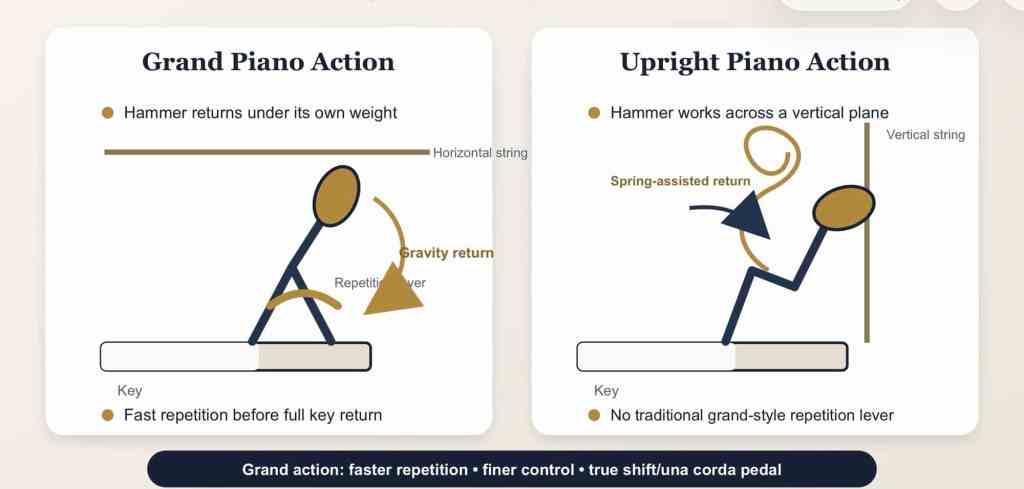
An acoustic grand action

The piano action—the mechanical system that connects the keys to the hammers—is what makes an acoustic piano unique.

When you press a key on an acoustic piano, you’re engaging a real mechanical process:

1. A system of levers transfers the motion to a hammer.

2. The hammer strikes a string, producing a rich, resonant tone.

3. The dampers control the sustain, responding naturally to the player’s touch.

This entire mechanism gives the pianist control over dynamics (volume), articulation (attack and release), and phrasing (musical expression). It also helps develop proper finger strength and independence, essential for advanced piano playing.

What About Keyboards with Weighted Keys?

keyboard action (Roland model)

Many digital keyboards advertise weighted keys and touch sensitivity, giving the impression that they are similar to an acoustic piano. While these features are certainly better than a basic, unweighted keyboard, they still fall far short of the experience and benefits of playing on a real acoustic piano.

Why?

• Weighted keys on a keyboard do not replicate the true hammer action of an acoustic piano. Instead, they often use springs or simple counterweights that imitate resistance but lack the full range of motion, escapement, and feedback of an acoustic mechanism.

• Touch sensitivity does not equal dynamic control. Even if a keyboard responds to how hard you press, the difference in sound is digitally programmed, not physically produced. A real piano allows for infinite gradations of tone based on a pianist’s technique—something that no standard digital keyboard can truly replicate.

• The keybed lacks depth and nuance. On an acoustic piano, there is a slight resistance at the beginning of a key press, a “let-off” sensation (escapement), and a responsive rebound after the hammer strikes the string. Most keyboards—even with weighted keys—fail to replicate this complex tactile feedback.

For serious students, a low-cost keyboard with weighted keys is still an inadequate substitute for a real piano. It may help a beginner get started, but in the long run, it hinders progress and creates bad habits that must be corrected later.

What Happens When You Learn on a Cheap Keyboard?

A student practicing on an inexpensive keyboard often encounters these long-term challenges:

1. Weak Finger Strength & Poor Technique

Since a keyboard lacks the proper hammer action and resistance, students do not develop the necessary strength and control in their fingers.

• Their hands become accustomed to light key presses rather than the full engagement required on an acoustic piano.

• When they transition to a real piano, they struggle to articulate notes properly, lacking the stamina and dexterity needed for advanced repertoire.

2. Limited Dynamic Control

On a real piano, playing softly or loudly is a result of how the hammer strikes the string. A cheap keyboard uses pre-recorded samples, meaning the dynamic range is artificially programmed rather than physically produced.

• A student learning on a keyboard misses out on true expressive control, making their playing sound flat and mechanical.

• Without proper exposure to real acoustic dynamics, their ability to interpret music expressively is stunted.

3. Difficulty Transitioning to an Acoustic Piano

Students who start on an inexpensive keyboard often find it jarring when they move to a real piano. They must suddenly:

• Adjust to the added weight and depth of acoustic piano keys.

• Learn nuanced touch control that they never developed on the keyboard.

• Develop better articulation, finger strength, and coordination—skills that would have come naturally had they started on an acoustic instrument.

What About High-End Digital Pianos and Hybrid Pianos?

While an acoustic piano remains the best option for learning, not everyone has the space or budget for one. In that case, a high-quality digital piano or hybrid piano is a far better alternative than an inexpensive keyboard.

Best Digital Piano Options for Serious Learners

• High-End Digital Pianos – Instruments like the Kawai CA501 or Yamaha CLP-785 offer highly realistic key actions and advanced sound engines that closely mimic an acoustic piano. While still digital, they provide a much more authentic playing experience compared to lower-end keyboards.

• Hybrid Pianos – These are the closest digital instruments to an acoustic piano. Models like the Kawai NV6 or NV10S feature real acoustic hammer actions (not just weighted keys) but use digital sound engines instead of strings. This provides an authentic touch experience while eliminating tuning and maintenance concerns.

If an acoustic piano is not an option, investing in a high-quality digital or hybrid piano will give students a far better foundation than an inexpensive keyboard.

Conclusion: Invest in the Right Foundation

Learning piano on an acoustic instrument isn’t just about sound—it’s about developing the right technique, strength, and musical expression from day one.

A serious pianist needs an instrument that responds, challenges, and inspires.

• Avoid inexpensive keyboards, even if they have weighted keys and touch sensitivity.

• If an acoustic piano isn’t an option, invest in a high-quality digital or hybrid piano for a more realistic experience.

• The right instrument makes all the difference in a pianist’s long-term success.

Starting on the right piano is not just a purchase—it’s an investment in musical growth.

Why Do Modern Pianos Only Have 88 Keys?

There have been many reiterations of the piano over the past few centuries. Even today some pianos are being made with upwards of 100 keys. Still, 88 keys have been the standard for the last 120 years.

The reason 88 keys still remains the standard is partially due to tone. Once a piano starts producing notes below the lowest A on the keyboard, the tones become almost unrecognizable.

This is because the frequency range is incredibly low, and the human ear can only hear comfortably beyond a certain range. The same can be said for pitches that are beyond the highest C on the piano.

The other reason pianos are at 88 keys is because there simply are not enough compositions to warrant a mass expansion of the instrument.

With the exception of some modern works and electronic music, there is almost no repertoire that uses pitches beyond the standard 88 keys. Beyond the low A, no one makes use of anything beyond this range.

Another issue with taking the piano beyond 88 keys is the size. Not only does the piano have to extend from side to side, but it also has to extend from end to end. Without that increase in the size of the piano casing, some of those pitches would not properly sound.

While the standard concert grand is at least 9′, some are reaching sizes of over 10′ just to help accommodate the additional octaves added to the instrument. This can be problematic when trying to add pianos of this size to your home let alone a crowded concert stage.

More keys also mean more strings. More strings mean more tension. To build a piano with more keys requires more customized parts.

Costs to produce these pianos are also a factor. Piano manufacturers have to continue pouring money into research and design to make these instruments. They also require more wood, materials, and labor to build.

Production on a bigger piano takes time. The average piano takes 1 to 3 years to complete in it’s normal 88 key states. More keys add to that time.

The Harpsichord Had Its Limits

Before there was the piano, there were a number of other keyboard instruments. However the most successful of those instruments at the time was the harpsichord.

Invented in the middle ages, the harpsichord was the standard instrument and grew in popularity by the late 16th century. Composers such as Bach, Scarlatti, and Handel composed thousands of pieces for the instrument.

It was generally well received at the time, but as the music began to modernize, the harpsichord began to run into some walls. Because of its limited 5 octave range, the piece was not a great fit with some of the newer orchestral pieces and advancement of other instruments.

The limited range made it less tasteful to audiences, and the range of music was extremely limited as a result. Not only that, but the harpsichord was extremely limited in its dynamic range.

The Fortepiano Was Created To Replace The Harpsichord

To help expand on what the harpsichord could do, the fortepiano was created. Bartolomeo Cristofori created an instrument that featured a hammer mechanism to strike the strings. This has evolved into what we know it as today, the modern piano.

The fortepiano featured the first expansion on the performance capabilities of the harpsichord. Both the harpsichord and the fortepiano have 60 keys.

What’s interesting about the fortepiano is that the keyboard colors are the inverse of what we know about today’s pianos.

Dynamically this instrument has the ability to vary the sound. It can produce a soft tone, midrange tone, and loud tone just like today’s modern pianos. There are also different tone qualities in each of the ranges.

Unlike today’s pianos though, there is a lot less sustain with the fortepiano, and it also used knee stop and knobs instead of pedals to aid in that.

Composers such as Beethoven began composing pieces that required greater demands out of the instrument. In this period especially, pianos began to undergo certain transformations. The primary change, however, was the increase in the number of keys.

Steinway Established The 88 Key Piano As The Standard

To satisfy the need of composers and to further the development of the piano, Steinway created the 88 key piano. At the time there were pianos with 85 keys, and some with less, however, it was not widely sought to add more keys.

Steinway, however, made the move to add additional keys to the 85 key model to make it 88. The piano as we know it today has 7-octave ranges. In total that gives us 52 white keys and 36 black keys.

Being that Steinway was one of the largest piano manufacturers in the 1880s, others saw this move and followed suit. The expanded piano allowed for a better balance between tenor and bass range to go with the treble.

Many compositions at this time were Romantic and starting to head into 20th-century works. Use of the extreme ranges of the piano had become popular, especially in Rachmaninoff and Cage’s music.

The Future Of The Piano

With the rise in composition software, electronic music, and new instruments being invented every day, the advancement of the piano is more important than ever.

Thanks to technological advancements in woodworking and acoustics, several piano builders are adding in all sorts of cool features.

This includes piano player systems, removable tuning components, and longer lasting gold plated action parts. Pianos are even being developed using special CAD software for ultimate precision.

Perhaps the most impressive development is the addition of extra octaves. Brands like Bosendorfer and Stuart and Sons are known for these unique instruments. Bosendorfer, for example, has a 92 and 92 key model.

The extra octaves are added to the bass which produces unique tones that otherwise would not have been heard. Then there is Stuart and Sons who makes a 102 and 108 key grand piano.

As more and more large pianos are being constructed, more composers will start creating music that makes use of those notes. It will, however, be quite sometime before this becomes standard as the low A on the piano has been in use for nearly 150 years.

Do All Pianos Have 88 Keys? All pianos do not have 88 keys. Some older pianos have 85 keys. Modern pianos have 92, 97, 102, and even 108 keys. Most of the keys add an additional 1 to 2 octaves in the bass range of the instrument. Bosendorfer and Stuart and Sons are makers of pianos with additional

Enrico Aquino

Hello & thanks for stopping by! I’m a professional concert pianist and piano instructor and of course Owner and Proprietor of Worldwide Piano and Music School. I have performed in such venues as Carnegie Hall and Lincoln Center as well as other Concert Venues. I look forward to educating you on different aspects of pianos through our new Piano Blog