Why Grand Piano Actions Are Superior to Upright Actions
Many piano shoppers begin with the same assumption: “I would love a grand piano, but I only have room for an upright.”
Sometimes that is true. Often, it is not.
A grand piano does use more floor area than an upright piano, and no honest piano professional should pretend otherwise. But square footage is only one part of room planning. A compact baby grand piano is approximately the same width as a full-size upright, its bench can tuck beneath the keyboard, and its curved shape can turn an awkward corner or underused area into the focal point of the room.
Once furniture, bench clearance, traffic flow and the way a room is visually balanced are considered, a baby grand can fit far more comfortably than its measurements suggest.
The more important difference, however, is educational and musical. A baby grand is not merely an upright piano in a more decorative case. It uses a true grand piano action—an action designed to respond more quickly, repeat more naturally and give the pianist greater control over tone, dynamics and advanced technique.

The Fundamental Difference: How Grand and Upright Piano Actions Work
The action is the system of keys, levers, hammers, dampers and related parts that translates the movement of a pianist’s finger into sound.
Both grand and upright actions can be beautifully engineered and precisely regulated, but their geometry is fundamentally different.
A Grand Action Works With Gravity
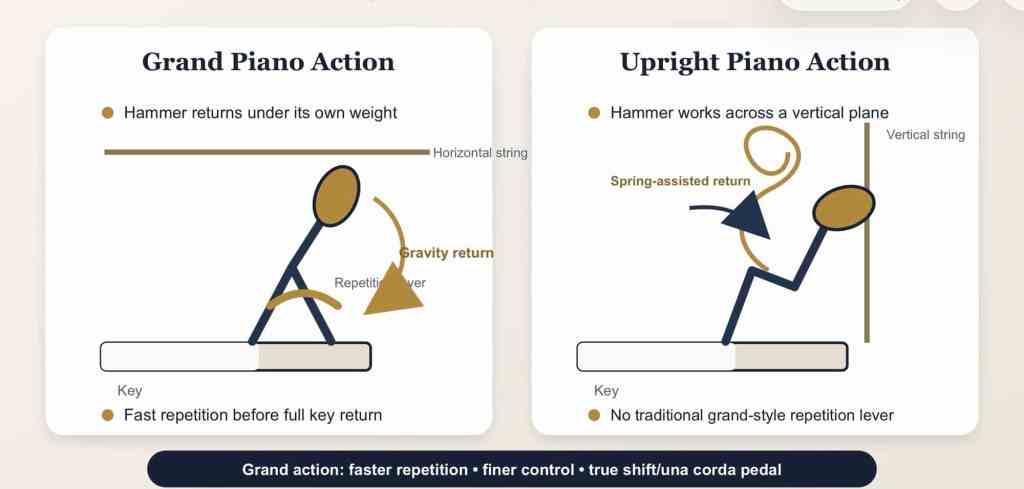
In a grand piano, the strings and hammers are arranged horizontally. After a hammer strikes a string, gravity helps it return naturally under its own weight.
This direct relationship with gravity contributes to the smooth, predictable response pianists associate with a well-regulated grand action.
In an upright piano, the strings are vertical and the hammers move toward them in a more horizontal path. Springs and other action components help return the hammers to position.
Modern upright actions can be excellent, but they still operate within the physical limits of vertical action geometry.
A Grand Has a Repetition Lever and Double-Escapement Action
The defining advantage of the modern grand piano action is its repetition system, often described as double escapement.
It allows a note to be repeated before the key has risen all the way back to its starting position. This matters in rapid repeated notes, trills, ornaments, tremolos and any passage requiring speed with control.
Yamaha’s comparison of grand and upright pianos explains that a grand can repeat a note at roughly 15 times per second, compared with approximately seven times per second for an upright.
A pianist may never consciously count those repetitions, but the difference can be felt immediately in demanding music—and in the sense that the action is keeping up with the player rather than asking the player to compensate for it.
[Insert action diagram: grand-vs-upright-piano-action-comparison.svg]
Grand Actions Give the Pianist Finer Control
Speed is only part of the story. The best reason to choose a grand action is control.
A responsive grand piano action helps a pianist:
- Play more softly without notes failing to sound.
- Shape a melody above an accompaniment.
- Create smoother legato phrasing and cleaner articulation.
- Control repeated notes, trills and rapid passages more reliably.
- Explore a wider range of tone color and dynamics.
These are not benefits reserved for concert pianists. They are the building blocks of good piano education.
Students learn through the feedback an instrument gives them. When the action responds faithfully, the student can hear and feel the difference between a controlled touch and an uncontrolled one.
Grand Pedals Provide Additional Musical Possibilities
On a traditional grand piano, the left pedal is a true una corda, or shift pedal. It moves the action sideways so the hammers strike a different portion—or, in much of the piano, fewer strings. This changes not only the volume but also the tone color.
The middle pedal is generally a true sostenuto pedal, allowing selected notes to continue sounding while other notes remain unaffected.
Many upright pianos instead use a soft pedal that moves the hammers closer to the strings and a middle practice pedal that lowers felt between the hammers and strings. Those features are useful, but they do not offer the same expressive functions as the traditional grand-piano pedal system.
Pedal configurations can vary by model—including on some compact grands—so buyers should confirm the functions of the specific piano they are considering.
Why a Grand Piano Can Be the Better Educational Instrument
A beginning student does not need to play advanced repertoire on the first day. The goal, however, should not be to purchase an instrument that the student will quickly outgrow.
A quality grand piano can remain appropriate from the first lesson through advanced study.
It Teaches Technique That Transfers to Performance Instruments
Recital halls, college music departments, audition spaces and concert stages use grand pianos.
Practicing regularly on a grand action helps a student become comfortable with the response, pedal functions and dynamic range likely to be encountered in performance.
It Does Not Place an Early Ceiling on Developing Technique
As repertoire becomes more sophisticated, students encounter fast repetition, wide dynamic contrasts, voicing between the hands and delicate pianissimo playing.
A grand action gives students the mechanical capacity to develop those skills instead of forcing them to learn workarounds that may later need to be unlearned.
It Makes the Musical Reward More Immediate
A responsive instrument makes small improvements audible.
Better balance sounds better. Cleaner articulation sounds cleaner. More intentional phrasing is rewarded with a more expressive musical result.
This can make practicing more satisfying because the piano becomes an active partner in the learning process.
One important qualification should be made: condition and preparation matter. A finely regulated professional upright can outperform a neglected, poorly built or badly maintained grand.
“Grand” describes the design. It is not an automatic guarantee of quality. The correct comparison is between well-made, properly prepared instruments in similar condition.
Other Advantages of a Grand Piano
Greater Tonal Range and Sound Projection
As grand pianos become longer, they can accommodate longer strings and larger soundboards, supporting greater resonance, bass clarity and dynamic range.
Even a compact baby grand benefits from a horizontal soundboard and an adjustable lid that projects sound upward and into the room. The lid can be fully raised, placed on a short stick or closed to help tailor the piano’s projection to the size and acoustics of the room.
Yamaha notes that grand pianos generally offer greater dynamic range and emit sound from above, while upright-piano sound projects primarily from the back of the instrument—often directly toward a wall.
This gives a grand piano a more open, room-filling presentation and helps listeners hear a broader range of tonal color.
A More Social Playing Position
At an upright piano, the pianist usually faces the wall. At a grand piano, the keyboard can face into the room.
The pianist can see a teacher, family members, other musicians or guests without turning away from the instrument. This makes the piano more naturally part of lessons, gatherings, rehearsals and everyday family life.
It is much easier for someone playing a grand piano to feel connected to the room instead of feeling separated from everyone else.
An Instrument That Can Grow With the Player
Buying a quality grand piano early may avoid the cost and disruption of replacing a starter instrument when the student advances.
The same piano can serve a beginner, an experienced player, a teacher, visiting musicians and future generations in the household.
Customers who want flexibility can explore Worldwide Piano’s selection of grand pianos for sale, including new, used and rebuilt instruments in different sizes and price ranges.
Does a Baby Grand Piano Really Take Up That Much More Room?
The honest answer is that a baby grand uses more floor area than an upright.
The more useful answer is that it may not consume much more usable room.
Almost every modern acoustic piano has an 88-note keyboard, so both grand and upright pianos are close to five feet wide. Yamaha’s room-size guidance likewise notes that nearly all pianos are approximately five feet wide because of the standard keyboard.
The principal difference is what extends behind the keys.
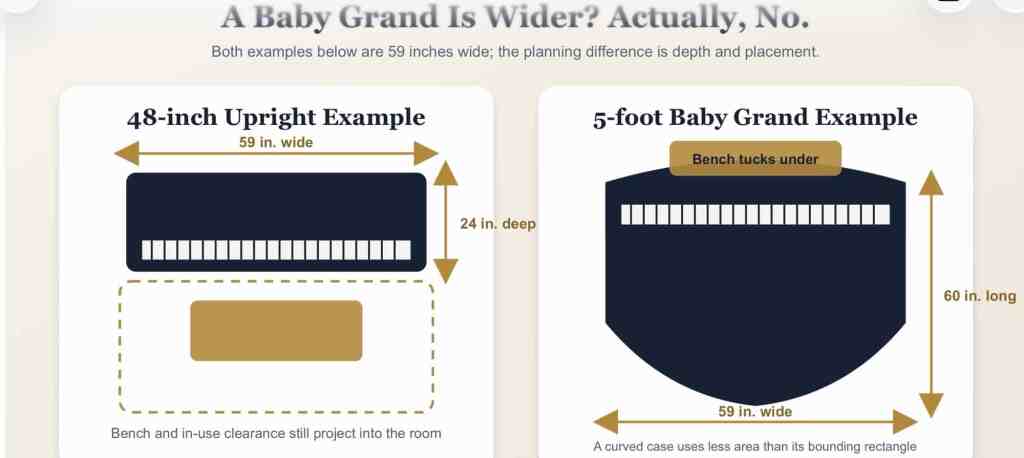
For a real-world comparison, the Kawai K-300 upright is 59 inches wide and 24 inches deep.
The Kawai GL-10 baby grand is also 59 inches wide and is 5 feet long.
The baby grand clearly has a larger footprint, but it does not require a wider wall or a wider keyboard area.
An Upright Affects the Room Beyond Its Cabinet Dimensions
An upright piano is often described only by the approximately 24 inches between the wall and the front of its cabinet.
When it is being played, however, it also requires a bench and sufficient space for the pianist behind the bench. The upright claims roughly five feet of wall space, and the playing area still projects into the room.
There is also a furniture-design issue that is easy to overlook.
Placing a large upright piano on one wall does not automatically complete the room. Many rooms still need a console, bookcase, artwork, seating or another substantial decorative element on the opposite wall to feel balanced.
By contrast, a baby grand can perform several visual jobs at once. It is a musical instrument, sculptural furniture, a focal point and an anchor for the room’s layout.
You are not simply losing space to a piano. The grand may replace furniture and decorations you would otherwise have to purchase and position elsewhere in the room.
Space-Saving Ways to Position a Baby Grand Piano
1. Point the Keyboard Into the Room
This is often the most attractive and practical arrangement.
With the keys facing into the room, the pianist looks toward the seating area instead of toward a wall. When the piano is not in use, the bench slides largely beneath the keyboard.
The space required for the seated pianist becomes available circulation space again.
This placement also allows the piano to become part of the room instead of appearing to be something that was simply pushed against a wall.
2. Use a Diagonal or Caddy-Corner Placement

A diagonal placement can turn an awkward corner into a dedicated piano area.
Aim the narrow tail toward the corner and the keyboard toward the center of the room. Although the piano occupies the visual territory of two adjoining walls, it can free the room’s primary long wall for a sofa, media cabinet, bookcase or storage.
This placement can also prevent the piano from interrupting the main traffic path through the room.
3. Place the Straight Side Near an Interior Wall
When the room allows it, placing the straight bass side near an interior wall and allowing the open side of the lid to project toward the room can support both sound and visual flow.
Keep the piano away from direct sunlight, exterior-door drafts, radiators, fireplaces and direct HVAC airflow.
Stable temperature and humidity are more important than following a single supposedly perfect orientation.
4. Make a Full-Size Floor Template Before Deciding
Do not judge whether a baby grand piano will fit from a showroom photograph or a tape measure alone.
Mark the exact outline of the piano on the floor with painter’s tape or use a paper template. Then add the bench and the space required for a seated pianist.
Walk through the room. Open nearby doors, cabinets and drawers. View the outline from adjoining rooms and hallways.
Steinway even offers a grand piano floor-template guide for visualizing different piano sizes.
Many customers are surprised by how naturally a baby grand fits once they see its actual outline in the room.
A Grand Piano Is Furniture, Architecture and a Statement Piece
A grand piano has a visual presence that few other pieces of furniture can equal.
Its curved rim, raised lid, long horizontal line and three-dimensional form naturally draw the eye. Instead of being another object placed against a wall, it organizes the room around itself.
From a design perspective, a grand piano can communicate sophistication, craftsmanship, cultural curiosity and a worldly appreciation of music and the arts.
It can feel formal without being cold, luxurious without being merely decorative and traditional without requiring a traditionally decorated room.
A polished ebony grand piano can provide beautiful contrast in a modern interior. Satin woods can add warmth. Art-case finishes can function almost like pieces of functional sculpture.
Most importantly, a grand piano is not a statement piece that only sits there.
It can support a child’s first piano lesson, an adult’s return to music, a family sing-along, a holiday gathering or a serious musical performance.
Its beauty and its purpose are inseparable.
When an Upright Piano May Still Be the Right Choice
A grand piano is not the correct choice for every room or every budget.
A high-quality upright piano may be preferable when:
- Floor area is extremely limited.
- The instrument must fit in a narrow hallway, bedroom or small teaching room.
- The buyer can purchase a higher-quality upright instead of a lower-quality grand at the same price.
- Volume control or a practice pedal is especially important.
- The room has no workable grand-piano traffic pattern.
The goal is not to dismiss upright pianos.
It is to prevent buyers from ruling out a baby grand based on an exaggerated idea of how much room it requires—or without understanding the educational and musical advantages of a true grand piano action.
Frequently Asked Questions About Grand Pianos and Baby Grands
Is a Grand Piano Action Really Better Than an Upright Action?
For repetition, dynamic control and advanced technique, a well-regulated grand action has inherent mechanical advantages.
It works with gravity and includes a repetition lever that allows notes to repeat before the key returns fully. A quality upright can still be an excellent instrument, but the two action designs are not mechanically identical.
Is a Baby Grand Piano Good for a Beginner?
Yes. A beginner can benefit from the same responsive touch, pedal functions and tonal feedback that help an advanced pianist.
A quality baby grand can also prevent the need to upgrade simply because the student’s technique has outgrown the instrument.
How Much Space Does a Baby Grand Piano Need?
A compact baby grand is typically around five feet wide and five feet long. You should also plan for a bench and seated pianist when the instrument is being played.
The exact space required depends on the model, room shape, door swings and traffic paths. A full-size paper or painter’s-tape template is the best way to determine whether a particular piano will fit.
Can a Baby Grand Piano Fit in a Small Living Room?
Often, yes.
Keyboard-first placement, a bench that tucks under the piano and diagonal use of a corner can make a five-foot baby grand workable in rooms where buyers initially assumed only an upright piano would fit.
Always measure the specific piano rather than relying only on average dimensions.
Where Should a Grand Piano Face?
When possible, position the keyboard so the pianist faces into the room. This improves sightlines and makes playing more social.
For sound and instrument stability, consider placement near an interior wall and avoid direct sunlight, windows, exterior doors and direct HVAC airflow.
Experience the Difference Side by Side
The difference between a grand piano action and an upright action is easier to feel than it is to describe.
Play the same quiet passage, repeated-note pattern and chord progression on both instruments. Listen to the dynamic range. Notice how quickly the keys are ready to speak again.
Then compare the outline of a five-foot baby grand with the furniture already in your room.
Worldwide Piano in Edison, New Jersey offers a large and constantly changing selection of baby grand pianos for sale, full-size grand pianos, professional uprights and carefully selected pre-owned instruments.
You can browse our online piano shop, continue learning in the Worldwide Piano Information Center, or schedule an in-person or virtual piano appointment to compare touch, tone, size and value with an experienced piano specialist.
Do not assume a grand piano is too large for your home until you have measured a real one.
The baby grand you thought would never fit may be the instrument—and the centerpiece—your room has been waiting for.