
Which Hybrid Piano Feels More Like a Real Piano?
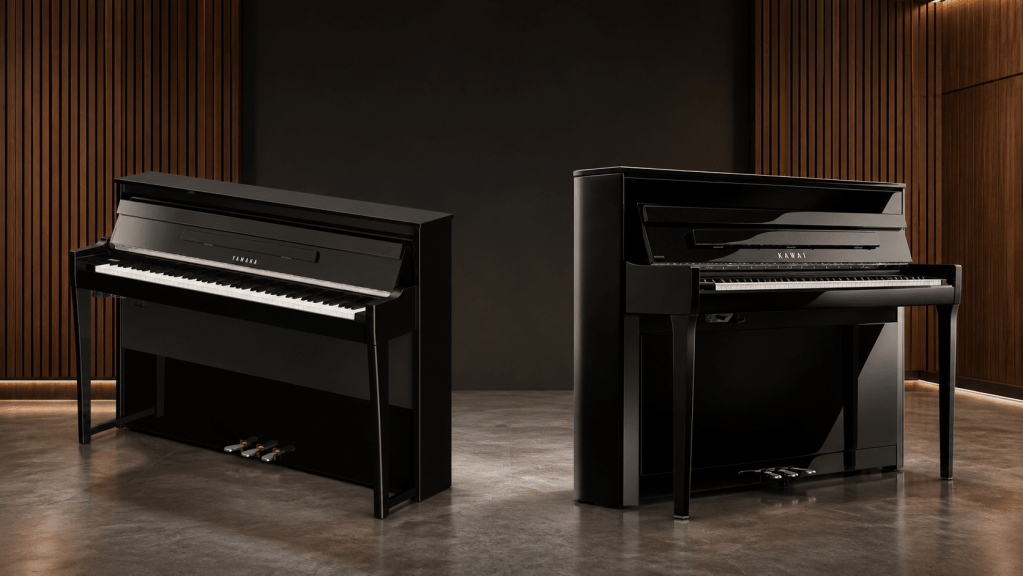
The Yamaha NU1XA and Kawai NOVUS NV6 are two of the most advanced hybrid upright pianos available in 2026. Both combine real wooden keys and an acoustic-style action with digital sound, headphones, recording features and freedom from regular tuning.
However, these instruments take different approaches to reproducing the experience of an acoustic piano.
The Yamaha NU1XA offers an excellent specialized upright action, sophisticated dual-sensor technology and the sounds of the Yamaha CFX and Bösendorfer Imperial concert grands. The Kawai NOVUS NV6 goes further mechanically by incorporating extended-length wooden keys, Kawai’s Millennium III Hybrid upright action and—most importantly—a genuine upright damper mechanism, often referred to as part of the piano’s back action.
That back action is not a small technical detail. It is one of the primary reasons the Kawai NV6 can feel more like a complete acoustic piano and less like a digital keyboard with an advanced action.
Model note: If you are searching for the “Yamaha NU1X,” Yamaha’s current model for 2026 is the updated NU1XA. The original NU1X is the previous-generation instrument. This comparison focuses on the current Yamaha NU1XA.
The Quick Answer: Yamaha NU1XA or Kawai NV6?
Both are excellent hybrid pianos, but they have different strengths.
The Yamaha NU1XA is a strong choice for pianists who prioritize:
- Yamaha CFX and Bösendorfer Imperial piano sounds
- Yamaha’s dual hammer-and-key Articulation Sensor System
- Binaural headphone sampling
- A 16-track internal MIDI recorder
- Smart Pianist app integration
- A choice of polished ebony or polished white
The Kawai NOVUS NV6 is the stronger choice for pianists who prioritize:
- The most authentic upright-piano touch
- A real acoustic upright damper and back-action mechanism
- Extended-length wooden key sticks
- A more consistent pivot when playing between the black keys
- Kawai’s Millennium III Hybrid action with ABS-Carbon components
- A wooden soundboard speaker system
- Modern USB-C recording and connectivity
For serious students, teachers and experienced acoustic-piano players, the NV6 has the more mechanically complete design.
Both Are Real Hybrid Pianos
A hybrid piano is fundamentally different from a conventional digital piano. Instead of using a compact digital key mechanism with simulated hammer weighting, a true hybrid uses real moving action parts based on those found in an acoustic piano.
The Yamaha NU1XA uses what Yamaha calls a “specialized upright piano action.” Yamaha confirms that the keyboard is made of wood and that the action moves real hammers.
The Kawai NOVUS NV6 uses Kawai’s Millennium III Hybrid upright action with 88 wooden keys, individually weighted moving hammers and contactless optical hammer sensors.
Therefore, it would be inaccurate to describe the NU1XA as merely a plastic keyboard. It is a legitimate hybrid instrument with a real upright-style mechanism. The more meaningful question is how much of an acoustic upright’s complete mechanical system each manufacturer retains.
This is where the Kawai NV6 separates itself.
The Back Action: The NV6’s Biggest Advantage
When a key is played on an acoustic upright piano, it does more than move a hammer toward a string.
The key and action also interact with the damper system. Each damper must lift away from its string when its note is played. Pressing the damper pedal moves an entire bank of dampers simultaneously.
Those wooden, felted and weighted components create physical resistance and feedback through the keys and pedal. This mechanical interaction is part of what makes an acoustic piano feel alive beneath the player’s hands.
A digital or hybrid piano does not technically need physical dampers. Software can sustain or stop a digitally generated note without moving any mechanical parts. Manufacturers can therefore eliminate the damper mechanism while still providing wooden keys and moving hammers.
The instrument may still feel very good, but part of the acoustic piano’s mechanical feedback is missing.
Kawai deliberately retains a real upright piano damper mechanism in the NV6, even though the mechanism is not necessary to control its digital sound. As Kawai explains, the system reproduces the extra load created by the traditional wood and felt components as the keys and damper pedal are pressed.
This is the NV6’s hidden giant.
The back action allows the player to feel mechanical resistance through both the keyboard and pedal. It helps the NV6 respond more like a complete acoustic upright rather than an electronic instrument with an excellent key action.
Yamaha equips the NU1XA with GrandTouch pedals and its GP Response Damper system, which are designed to create realistic pedal resistance and support half-pedaling. These are important strengths. However, Yamaha’s published NU1XA specifications do not identify a genuine acoustic upright damper mechanism behind the action.
Kawai does not merely simulate the back action’s effect. The NV6 physically includes it.
Extended Keys and a More Favorable Pivot
A piano key is a lever. The distance between the front of the key, its balance point and the rear of the key affects how much effort is required to play it.
This becomes especially noticeable when playing near the fallboard or between the black keys. On an action with shorter key geometry, the keys can become significantly firmer as the fingers move farther back.
Longer key sticks provide better leverage and can make the resistance more consistent from the front to the rear of the playing surface. This improves control when voicing chords, playing softly or performing music that requires the hands to play deeply into the keyboard.
Kawai states that the NV6 retains the extended-length key sticks found in its K Series acoustic uprights. According to Kawai, these longer key sticks provide greater control and a more even response across the playing surface.
Yamaha confirms that the NU1XA uses wooden keys, but the company does not publish a comparable extended-key claim or provide the key-stick length in its consumer specifications.
Without an official Yamaha measurement, it would be unfair to invent a millimeter-to-millimeter comparison. Nevertheless, the documented engineering advantage belongs to the Kawai NV6.
This improved pivot is one of the differences a pianist can feel immediately when playing chords near the backs of the keys.
Millennium III Hybrid Action vs. Yamaha’s Specialized Upright Action
The NV6’s Millennium III Hybrid action is based on Kawai’s proven acoustic upright action design.
It combines:
- 88 full-length wooden keys
- Extended-length key sticks
- Grade-weighted moving hammers
- ABS-Carbon action components
- Contactless optical hammer sensors
- A genuine upright damper mechanism
Kawai uses ABS-Carbon in critical action components because it is lighter, stronger and more dimensionally stable than conventional wooden parts. This is not simply inexpensive plastic. It is a carbon-fiber-reinforced composite engineered for stiffness, speed and resistance to changes caused by humidity.
Kawai still uses wood where the weight and physical character of wood are beneficial—most notably in all 88 keys. Advanced composite materials are used in areas where low mass, strength and consistency improve performance.
According to Kawai’s explanation of the Millennium III action, its ABS-Carbon components allow the action to be approximately 16% to 25% faster than a traditional all-timber action.
The NV6 also uses individually grade-weighted hammers. The bass hammers are weighted more heavily, while the hammers become progressively lighter toward the treble, just as they would in an acoustic instrument.
Yamaha’s specialized upright action is also a legitimate acoustic-style mechanism with wooden keys and moving hammers. Yamaha does not, however, publish the same detailed materials explanation for its internal action components.
Both actions are considerably more authentic than a conventional digital keyboard. The Kawai has the advantage of a clearly documented extended-key design, Millennium III composite components and a real damper/back-action assembly.
Yamaha’s Articulation Sensor System Is Excellent
Yamaha’s strongest technical advantage is its sensing technology.
The NU1XA uses continuous, noncontact electromagnetic sensors to measure both hammer movement and key release. One sensor tracks the hammer—the action component most closely related to producing an acoustic piano tone. A separate key sensor monitors how the key is released and helps the sound engine determine how the note should end.
This dual-sensor arrangement is known as Yamaha’s Articulation Sensor System.
It can capture subtle differences in repeated notes, quiet playing, key releases and legato transitions without placing physical contacts in the path of the action.
This is a meaningful Yamaha advantage and should not be minimized. The NU1XA does an excellent job translating the pianist’s physical movements into digital sound.
The Kawai NV6 uses its Integrated Hammer Sensing System, or IHSS. High-resolution contactless optical sensors monitor the movement of each hammer without interfering with the action.
Yamaha gathers additional information directly from the key release, while Kawai emphasizes reading the movement of the hammers within a more mechanically complete upright action.
Yamaha CFX and Bösendorfer vs. Shigeru Kawai SK-EX
Sound preference is more subjective than action design.
The NU1XA includes samples of two highly respected concert grand pianos:
- Yamaha CFX
- Bösendorfer Imperial
The Yamaha CFX is known for clarity, projection and a powerful modern concert sound. The Bösendorfer Imperial provides a warmer, darker and more traditionally Viennese tonal character.
Yamaha enhances these sounds with Virtual Resonance Modeling and Grand Expression Modeling. The NU1XA also includes binaural sampling of both flagship piano voices for an immersive experience through headphones.
The NV6 is built around the sound of Kawai’s flagship Shigeru Kawai SK-EX concert grand. Its SK-EX Rendering engine combines multichannel sampling with 88-key resonance modeling.
The current NV6 includes recordings of both the SK-EX Competition Grand and SK-EX Concert Grand. These provide multiple tonal characters while maintaining the warmth, color and broad dynamic range associated with Shigeru Kawai instruments.
Players who prefer the clear attack of the Yamaha CFX or the distinctive warmth of the Bösendorfer may favor the NU1XA. Pianists who prefer the tonal depth and lyrical character of the Shigeru Kawai SK-EX may prefer the NV6.
There is no universal winner in piano tone. This portion of the comparison should be decided by listening and playing in person.
Speaker Systems and Room Experience
The Yamaha NU1XA uses upward-facing woofers and specially designed bidirectional-horn tweeters. Its amplification system is rated at a combined 170 watts and is designed to project sound throughout the cabinet and into the room.
The Kawai NV6 uses six speaker drivers working with a wooden soundboard speaker system. Its total amplification is rated at 135 watts.
Wattage alone does not determine sound quality. Speaker placement, cabinet resonance, digital processing and the way the instrument distributes sound are equally important.
Kawai’s wooden soundboard gives the NV6 an acoustic-style method of transmitting sound through the instrument’s cabinet. The physical vibration can make the tone feel less as though it is coming from individual speakers and more as though it is emerging from the piano itself.
Yamaha’s speaker system is powerful, spacious and highly detailed. Kawai’s soundboard-based system may feel more physically integrated with the cabinet and playing experience.
Digital Features and Connectivity
The NU1XA includes several advantages for players who use onboard recording and educational features:
- 28 preset voices
- 16-track MIDI recording
- Extensive built-in lesson content
- Yamaha Smart Pianist compatibility
- Bluetooth audio and MIDI
- USB-to-host and USB-to-device connections
- Traditional MIDI In and Out
- WAV audio recording and playback
The NV6 offers a larger internal sound library and a more modern physical interface:
- Five-inch anti-glare touchscreen
- 96 Harmonic Imaging XL sounds
- Multiple SK-EX Rendering characters
- Bluetooth 5-series audio and MIDI
- USB-A connectivity
- USB-C host connection
- Integrated 44.1 kHz/24-bit USB audio interface
- 15-watt USB-C power delivery
- MP3 and WAV recording and playback
- Kawai PianoRemote app compatibility
The NV6’s touchscreen can fade out automatically while the piano is being played, preserving the appearance of a traditional acoustic upright.
For musicians recording directly to a computer or mobile device, the NV6’s built-in USB-C audio interface is particularly convenient. The Yamaha’s 16-track internal recorder, however, is considerably more capable than Kawai’s two-part onboard recorder.
Cabinet Size and Finish
The two instruments require almost the same amount of floor space.
The Yamaha NU1XA measures approximately:
- 59 1/8 inches wide
- 18 3/16 inches deep
- 40 5/16 inches high
- 238 pounds
The Kawai NV6 measures approximately:
- 59 inches wide
- 18 1/3 inches deep
- 43 1/3 inches high
- 247 pounds
The NV6 is approximately three inches taller and nine pounds heavier, but the width and depth are nearly identical.
Yamaha offers the NU1XA in polished ebony and polished white. The Kawai NV6 is currently offered in polished ebony.
Which Hybrid Piano Should You Choose?
Choose the Yamaha NU1XA if your priorities include:
- Yamaha CFX and Bösendorfer Imperial piano sounds
- Continuous dual hammer-and-key sensing
- Binaural headphone sampling
- A 16-track internal recorder
- Smart Pianist integration
- A polished-white cabinet option
The NU1XA is an excellent hybrid piano and represents a considerable improvement over a conventional digital action.
Choose the Kawai NOVUS NV6 if your first question is:
Which hybrid feels most like a real acoustic upright piano?
The NV6’s extended wooden keys, favorable pivot geometry, Millennium III Hybrid action and genuine upright damper/back action address the playing experience at its mechanical source.
The back action restores resistance and feedback that software and a weighted pedal can approximate but cannot physically reproduce in exactly the same way.
For serious piano students, teachers, institutions, experienced players and families seeking silent-practice convenience without sacrificing authentic acoustic-piano mechanics, the Kawai NOVUS NV6 is the stronger overall choice.
Yamaha may win for a particular pianist based on sound preference, sensing technology, recording features or cabinet finish. Kawai wins the central argument about mechanical completeness.
Final Verdict
The Yamaha NU1XA is a sophisticated and highly capable hybrid piano. Its Articulation Sensor System, Yamaha CFX and Bösendorfer sounds, binaural headphone sampling and multitrack recorder are genuine advantages.
The Kawai NOVUS NV6 is the more complete hybrid upright.
Kawai preserves not only the wooden keys and moving hammers, but also the extended key geometry, Millennium III action and genuine damper/back-action mechanism that contribute to the physical experience of playing an acoustic piano.
That back action is the difference many pianists feel but cannot immediately identify. It is a major reason the NV6 feels less like a keyboard and more like a real piano.
Experience the Kawai NV6 in New Jersey
Action geometry, damper feedback and soundboard resonance are difficult to judge from specifications alone. The best comparison is made at the keyboard.
Play softly, repeat notes, voice chords and press the keys close to the fallboard. Then compare the changing resistance through the damper pedal and keyboard.
Visit Worldwide Piano Stores in Edison, New Jersey to experience the Kawai NOVUS NV6 and receive a professional hybrid-piano consultation.
You can also view current information and availability on our Kawai NV6 Hybrid Piano product page or explore our complete selection of Kawai hybrid pianos.
Frequently Asked Questions
Is the Yamaha NU1XA a real hybrid piano?
Yes. The Yamaha NU1XA uses a specialized upright piano action with wooden keys, moving hammers and continuous noncontact sensors. It is considerably more authentic than a conventional digital piano action.
Does the Kawai NV6 have a real acoustic piano action?
Yes. The Kawai NV6 uses a Millennium III Hybrid upright action based on Kawai’s K Series acoustic upright design. It has 88 wooden keys, extended key sticks, grade-weighted hammers and ABS-Carbon action components.
What is the NV6’s back action?
The NV6 includes a genuine upright damper mechanism behind the keyboard action. This mechanism recreates the physical resistance and feedback produced by an acoustic piano’s dampers as the keys and damper pedal are pressed.
Why does back action matter in a hybrid piano?
Back action affects how the keys and damper pedal feel. Without a physical damper mechanism, a hybrid can still have wooden keys and moving hammers, but some of the resistance and mechanical feedback of an acoustic upright is missing.
Does the Yamaha NU1XA have a real upright damper mechanism?
Yamaha’s published specifications describe GrandTouch pedals, GP Response Damper technology and half-pedaling, but they do not list a genuine acoustic upright damper mechanism. Kawai specifically confirms that the NV6 includes one.
Which has the better key pivot?
Kawai documents that the NV6 uses extended-length key sticks designed to provide more even control from the front to the back of the playing surface. Yamaha confirms that the NU1XA has wooden keys but does not publish an equivalent extended-key specification.
Which sounds better, the Yamaha NU1XA or Kawai NV6?
That depends on personal preference. The Yamaha provides CFX and Bösendorfer Imperial concert-grand sounds. The Kawai features Shigeru Kawai SK-EX Competition Grand and Concert Grand sounds. Both should be played in person before deciding.
Which hybrid piano is better for serious students?
Both are suitable for serious study. However, the NV6’s extended keys, Millennium III action and genuine upright damper mechanism give it an advantage for students who need the closest possible transition between a hybrid piano and an acoustic upright.
Where can I try the Kawai NV6 in New Jersey?
The Kawai NOVUS NV6 can be experienced at Worldwide Piano Stores in Edison, NJ. Contact the showroom to confirm availability or schedule a private appointment.