Before you fall in love with a piano’s power, listen to its whisper.
Walk into a piano showroom and it is tempting to begin with a big chord. The bass fills the room, the treble rings, and the instrument immediately makes an impression.
But when comparing pianos, we recommend trying something quieter.
Whether you are considering a grand, an upright, a digital, or a hybrid piano, the ability to control quiet playing deserves your attention.
Play a simple melody softly. Add a gentle accompaniment. Repeat a few notes at a comfortable, low volume.
Can you control the sound easily? Does every note speak when you intend it to? Does the melody remain clear above the accompaniment?
Those small moments can tell you a great deal about how a piano responds. On an acoustic instrument, they can also reveal the quality of its preparation.
A Powerful Piano Should Also Be Easy to Control
A full, rich sound is one part of a piano’s appeal. Musical expression also depends on the ability to choose how much sound you produce.
Imagine playing a quiet passage where one note suddenly jumps out louder than the others. Or trying to repeat a soft note and having it fail to sound. Even when the piano has an impressive full tone, those interruptions can make playing frustrating.
A responsive instrument should help you produce the musical effect you intend across a useful range of dynamics.
At Worldwide Piano, we encourage buyers exploring our piano selection to compare responsiveness alongside tonal power.
Ask yourself: How much effort does it take to make this piano do what I want?
Why Soft Playing Is Such a Useful Test
When playing loudly, you may find it easier to overlook small differences between neighboring notes. At a quieter level, those differences can become more noticeable.
A simple, softly played scale may reveal notes that sound unexpectedly bright, feel less responsive, or require a different touch.
The purpose is to understand the instrument’s consistency. You want to feel that your fingers can make a musical choice and receive a predictable response.
Your technique matters, too. A single missed note is not a diagnosis of a mechanical problem. Repeat the passage, compare another instrument, and ask an experienced pianist or technician to demonstrate anything that concerns you.
How Preparation Shapes an Acoustic Piano’s Response
For acoustic grands and uprights, two important parts of piano preparation are regulation and voicing.
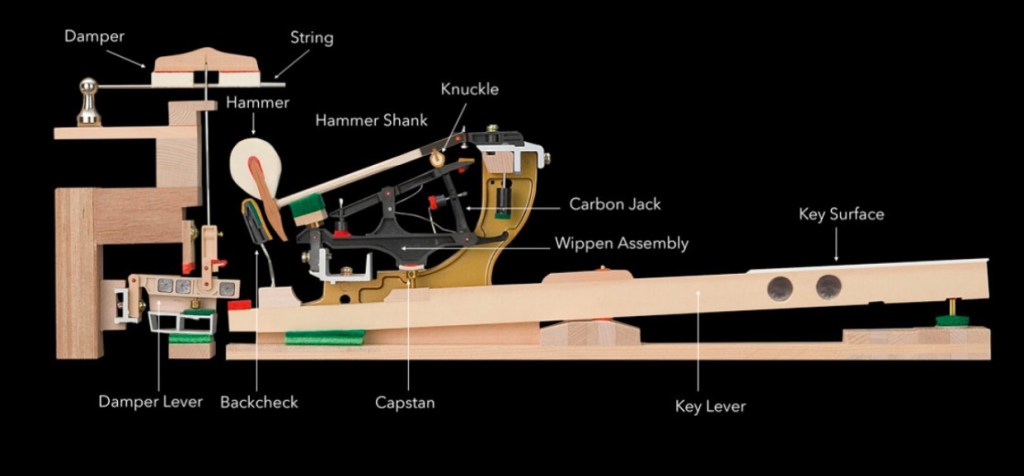
Regulation involves adjusting the action—the mechanism that translates a key movement into a hammer striking the strings. Careful regulation helps create consistent mechanical response and control.
Voicing develops the character and evenness of the tone. It can help a technician address notes that sound out of balance with their neighbors and refine the instrument’s musical personality.
An acoustic piano can be in tune while still needing attention to its touch or tone. Tuning alone does not complete the preparation process.
This is one reason we place so much value on our expert piano technicians and rebuilders. Their work helps the instrument respond to the person at the keyboard.
The Quiet Test Applies to Digital and Hybrid Pianos, Too
On a digital piano, lowering the volume makes the speakers quieter. Testing soft playing means keeping the volume setting steady and exploring how the sound responds when you vary your touch.
Can you play a gentle accompaniment beneath a clear melody? Does the sound change naturally as you play more firmly? Can you produce the quiet notes you intend without having to work around the keyboard’s response?
Digital and hybrid instruments differ in their mechanisms and sound systems, so their preparation needs are not identical to those of acoustic pianos. The musical question remains the same: does the instrument give you comfortable, predictable control?
A Light Touch Is Different From a Light Action
Buyers sometimes assume that easy quiet playing means the keys must feel unusually light.
Key resistance is only one part of the experience. A pianist may prefer a somewhat firmer action and still enjoy excellent control at low volume.
The useful question is whether the response feels comfortable, consistent, and manageable to you.
Try both quiet and moderately strong playing. Can you move between them naturally? Can you bring out a melody without making the accompaniment too loud?
These comparisons are often more revealing than deciding immediately that an action feels “heavy” or “light.”
Try This Five-Minute Piano Comparison
You do not need to play a concert piece to learn something useful.
1. Play a slow, quiet scale. Listen for notes that stand out and notice changes in response.
2. Repeat a few notes gently. Use a comfortable speed and observe whether the notes sound consistently.
3. Play a melody above soft chords. See how easily you can keep the melody clear.
4. Build gradually from soft to louder playing. Explore whether the transition feels natural.
5. Repeat the same material on another piano. Keep the seating and listening conditions as similar as practical. For acoustic grands, use comparable lid positions; for digitals, choose similar piano sounds and a comfortable listening level.
For the first part of the comparison, leave the sustain pedal off so you can hear individual notes clearly. Then add it to explore sustain, blending, and pedal response.
A showroom’s acoustics also affect what you hear. Ask how the piano might sound in your home, especially if your room has different flooring, furnishings, or proportions.
Beginners Can Learn From the Quiet Test, Too
You do not have to be an advanced pianist to value a responsive instrument.
If you are beginning, ask a member of our team to play the same short passage on several pianos. Listen for the balance between melody and accompaniment and for the variety of sound available.
Then sit down yourself. Even a few familiar notes can help you compare how comfortably the instruments respond.
A piano that makes musical control approachable can make practice more satisfying as your skills develop.
Find the Piano That Responds to You
Whether you are considering a new grand piano, a used upright, a rebuilt instrument, or a digital or hybrid piano, take time to explore its quieter side.
A powerful sound may attract your attention. Comfortable control is what you will live with every day.
At Worldwide Piano in Edison, New Jersey, we help customers compare tone, touch, and preparation through demonstrations and time at the keyboard.
Book a piano consultation or call 732-777-7381 to arrange your visit.
Before you choose your next piano, find out how beautifully it can whisper